Saturday, November 25, 2006

Information Awareness Office Projects


IAO Programs
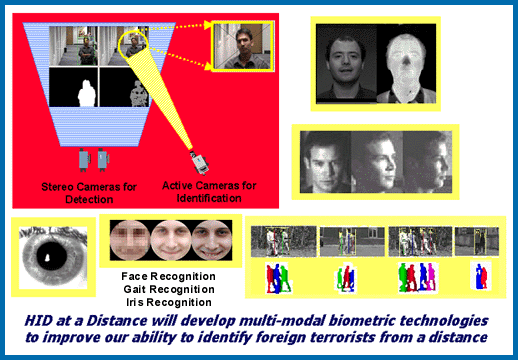
Human ID at a Distance (HumanID)

For use with surveillance camera – such as the dome cameras that began appearing everywhere in mid 2006.


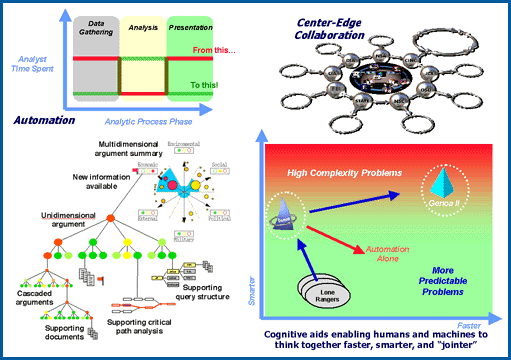
Genoa II


This would be used with analyzing “trees” of associations from such things as phone calls.

Genisys


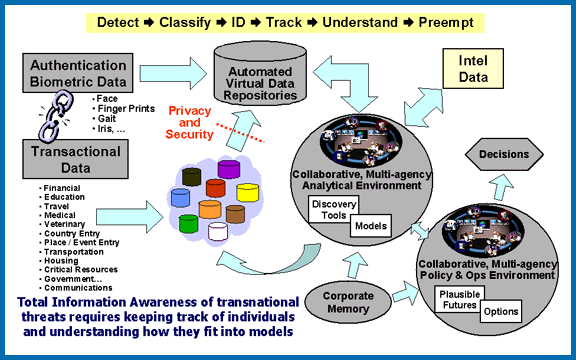
Total Information Awareness (TIA) System


This is the schematic for the government collecting and analyzing together a person’s records.

Friday, November 24, 2006

Total Information Awareness Ready Before 9/11

http://propagandamatrix.com/articles/december2004/061204tiaready.htm
Citizens For Legitimate Government | December 6 2004
Citizens For Legitimate Government can report today an exclusive story about the Total Information Awareness program (TIA), initiated by Admiral (retired) John Poindexter. CLG exclusive source tells us that a day after 9-11, Poindexter’s office of the TIA program was already established in the Pentagon. Says inside, unnamed source, Poindexter had the TIA program ready to roll out on 9/12/2001, the day after 9-11. Five days after 9-11, the TIA office was fully functional. Asked if that means the program was ready to rollout previous to 9/11, the source familiar with the program and privy to top-secret government contractors said, "of course."
The Total Information Awareness Program that was headed by Poindexter was disassembled after Congress decided against it, rightly asserting that it constituted an invasion of citizen privacy. TIA chief, Admiral John Poindexter, resigned August 29, 2003, amidst controversy over TIA as well as the revelation of a DARPA program that would have allowed investors to bet on assassinations and terror attacks.

However, the CLG's exclusive inside source familiar with program says that as is the case with all ghosts, they never really go away. The TIA program, headed by Poindexter, has been completely reassembled under an intelligence agency of the US government, operating under the same terms as intended by Poindexter. No longer called TIA, the new code name for the project is "Basketball." Under the name "Basketball," that is, TIA has bounced to a new office and is still collecting information about Americans.

http://www.legitgov.org/exclusive_tia_basketball_120204.html

http://www.legitgov.org/index.html

Wednesday, November 22, 2006

Knowledge is Power: IAO DARPA

Information Awareness Office
Scientia Est Potentia
Knowledge is Power
U.S. Defense Advanced Research Projects Agency
It is difficult to counter the threat that terrorists pose. Currently, terrorists are able to move freely throughout the world, to hide when necessary, to find unpunished sponsorship and support, to operate in small, independent cells, and to strike infrequently, exploiting weapons of mass effects and media response to influence governments. This low-intensity/low-density form of warfare has an information signature, albeit not one that our intelligence infrastructure and other government agencies are optimized to detect. In all cases, terrorists have left detectable clues that are generally found after an attack. Even if we could find these clues faster and more easily, our counter-terrorism defenses are spread throughout many different agencies and organizations at the national, state, and local level. To fight terrorism, we need to create a new intelligence infrastructure to allow these agencies to share information and collaborate effectively, and new information technology aimed at exposing terrorists and their activities and support systems. This is a tremendously difficult problem, because terrorists understand how vulnerable they are and seek to hide their specific plans and capabilities. The key to fighting terrorism is information. Elements of the solution include gathering a much broader array of data than we do currently, discovering information from elements of the data, creating models of hypotheses, and analyzing these models in a collaborative environment to determine the most probable current or future scenario. DARPA has sponsored research in some of these technology areas, but additional research and development is warranted to accelerate, integrate, broaden, and automate current approaches.

http://infowar.net/tia/www.darpa.mil/iao/index.htm

Here’s what The New Yorker and The New York Times said back in 2002 about the U.S. Department of Homeland Security’s data matrix infrastructure:
The Information Awareness Office plays it so weird that one can't help suspecting that somebody on its staff might be putting us on. The Information Awareness Office's official seal features an occult pyramid topped with mystic all-seeing eye, like the one on the dollar bill. Its official motto is "Scientia Est Potentia," which doesn't mean "science has a lot of potential." It means "knowledge is power." And its official mission is to "imagine, develop, apply, integrate, demonstrate and transition information technologies, components and prototype, closed-loop, information systems that will counter asymmetric threats by achieving total information awareness."

The phrase "total information awareness" is creepy enough to merit a place alongside "USA Patriot Act" and "Department of Homeland Security," but it is not the Information Awareness Office's only gift to the language. The "example technologies" which the Office intends to develop include "entity extraction from natural language text," "biologically inspired algorithms for agent control," and "truth maintenance." One of the Office's thirteen subdivisions, the Human Identification at a Distance (HumanID) program, is letting contracts not only for "Face Recognition" and "Iris Recognition" but also for "Gait Recognition." (Tony Blair has pledged the full coöperation of the Ministry of Silly Walks.) Another of the thirteen, FutureMap, "will concentrate on market-based techniques for avoiding surprise and predicting future events"—a sounder approach, ideologically, than regulation-based liberal soothsaying.

The Information Awareness Office is working on some really cool stuff that will eventually turn up at Brookstone and the Sharper Image, like a Palm Pilot-size PDA that does instantaneous English-Arabic and English-Chinese translations. But the Office's main assignment is, basically, to turn everything in cyberspace about everybody—tax records, driver's-license applications, travel records, bank records, raw F.B.I. files, telephone records, credit-card records, shopping-mall security-camera videotapes, medical records, every e-mail anybody ever sent—into a single, humongous, multi-googolplexibyte database that electronic robots will mine for patterns of information suggestive of terrorist activity. Dr. Strangelove's vision—"a chikentic gomplex of gumbyuders"—is at last coming into its own.

It's easy to ridicule this—fun, too, and fun is something the war on terrorism doesn't offer a lot of—but it's not so easy to dismiss the possibility that the project, nutty as it sounds, might actually be of significant help in uncovering terrorist networks. The problem is that it would also be of significant help in uncovering just about everything, including the last vestiges of individual and family privacy. This is why William Safire wrote the other day that the program should simply be shut down, as was Attorney General Ashcroft's Terrorism Information and Prevention System, which was going to enlist postal workers and the like as amateur spies.

At a minimum, a temporary shutdown, pending some sort of congressional review and the creation of safeguards, would seem to be in order…

http://www.newyorker.com/talk/content/articles/021209ta_talk_hertzberg?021209ta_talk_hertzberg">http://www.newyorker.com/talk/content/articles/021209ta_talk_hertzberg?021209ta_talk_hertzberg

You Are a Suspect

WILLIAM SAFIRE
November 14, 2002
If the Homeland Security Act is not amended before passage, here is what will happen to you: Every purchase you make with a credit card, every magazine subscription you buy and medical prescription you fill, every Web site you visit and e-mail you send or receive, every academic grade you receive, every bank deposit you make, every trip you book and every event you attend — all these transactions and communications will go into what the Defense Department describes as "a virtual, centralized grand database."
To this computerized dossier on your private life from commercial sources, add every piece of information that government has about you — passport application, driver's license and bridge toll records, judicial and divorce records, complaints from nosy neighbors to the F.B.I., your lifetime paper trail plus the latest hidden camera surveillance — and you have the supersnoop's dream: a "Total Information Awareness" about every U.S. citizen.

http://www.nytimes.com/2002/11/14/opinion/14SAFI.html?ex=1164344400&en=d09c57baa1330737&ei=5070

Mission

The IAO's stated mission is to gather as much information as possible about everyone in a centralized location for easy perusal by the United States government, including Internet activity, credit card purchase histories, airline ticket purchases, car rentals, medical records, educational transcripts, driver's licenses, utility bills, tax returns, and any other available data. In essence, the goal of the IAO is to be able to recreate a life history of thoughts and movements for any individual on the planet on demand, which the Bush administration deems necessary to counter the threat of terrorism. Critics claim the very existence of the IAO completely disregards the concept of individual privacy and liberties and is far too invasive and prone to abuse.

http://www.sourcewatch.org/index.php?title=Total_Information_Awareness


Since, this entity was supposedly disbanded.

Tuesday, November 14, 2006

Media Silence on USHS Threats to Free Speech


I notified dozens of contacts about this story, yet ... nothing.

I have no idea if Katie Couric was forwarded anything, but since she does do a "free speech" segment, covering the story of the South Capitol Mall Blogger, and other such stories, would be a logical way to boast her ratings.

Hint to Couric, report the news on U.S. Department of Homeland Security Threat to Free Speech.

Wednesday, November 08, 2006

Benjamin Franklin and Free Speech

Benjamin Franklin

From: http://www.halexandria.org/dward766.htm

New Page -- 6 September 2003

Benjamin Franklin was a babe magnet. This may not be the most noteworthy of his many talents, but then again, it might be. Of all the signers of the Declaration of Independence, it's nice to know that the crafty dodger was sufficiently cognizant of the feminine mystique to gain notoriety for being highly attractive to members of the female sex. It speaks well of any male politician to genuinely like women. It's the old, "Make love, not war" style innovation.

The standard accolades for Benjamin are things like "America's best scientist, inventor, diplomat, humorist and business strategist." [1] Yada, yada, yada. Perhaps Monsieur Franklin did indeed accomplish much. But then again, maybe he was just in the right spot at the right time. The more relevant question is what was his philosophy, what was his ideals and aversions, and most significantly, how did he manage to attract all those babes?

Walter Isaacson [1] does a commendable job in answering some of these questions, and organizes it around 7 virtues attributed to Franklin. These include:

bullet

1 -- An Aversion to Tyranny (So relevant today)

bullet

2 -- A Free Press (and by implication, a couple of hundred years later, Inter Net)

bullet

3 -- Humor (It's the babe thing.)

bullet

4 -- Humility

bullet

5 -- Idealism in Foreign Policy

bullet

6 -- Compromise

bullet

7 -- Tolerance

bullet

8 -- Babes (I added this)

bullet

9 -- 1776 (this too)

1 -- Franklin wrote prolifically in the pen name guise of a slightly prudish widow named Silence Dogood. [You've got to admire his choice of pen names!] In one instance, "she" wrote, "I am a mortal enemy to arbitrary government and unlimited power." [1]

This is the kind of succinct statement which can be mined extensively for meaning and value. From mortal enemy to arbitrary government, Dogood makes it clear upon which side she stands. "I am naturally very jealous for the rights and liberties of my country; and the least appearance of an encroachment on those invaluable privileges is apt to make my blood boil exceedingly." [1] Go get 'em, Silence!

According to Isaacson [1], Franklin also uses Mrs. Dogood "to attack the theocratic rule of the Puritan establishment and the link between the church and state that was then the very foundation of Massachusetts government." She goes on to say, for example, "A man compounded of law and gospel is able to cheat a whole country with his religion and then destroy them under color of law."

William Rehnquist -- currently the Chief Justice of the U. S. Supreme Court -- said, "The separation of church and state was 'a misleading metaphor based on bad history," and thereafter advocated that "the framers of the Constitution intended merely to forbid the establishment of an official state religion, as exists in England." Obviously he was unfamiliar with Benjamin Franklin and Ben's part in writing the Constitution for the United States. But then again, Willy Rehnquist seems unfamiliar with the Constitution itself and the liberties which it advocates.

This constitutional familiarity can be a common problem as the former Attorney General of the United States, failed Senator John Ashcroft, ignored the basis on which is oath of office was made, and routinely mixed "law and gospel" "under color of law" on a regular and unfortunately consistent basis. It is precisely these people and others like them which Benjamin Franklin would quite possibly consider to be mortal enemies. They are certainly mortal enemies of freedom loving Americans, and their continuing presence constitutes just one of the Perils of Democracy.

Benjamin Franklin's most relevant quote for the current age was also what became "an American rallying cry back in the early days of the Republic: 'Those who would give up essential liberty to purchase a little temporary safety deserve neither liberty nor safety'." [1] The current morass of the USA (anti) Patriot Act and the infliction upon America of the Homeland InSecurity Department makes this question of liberty and security the most important issue in the United States and the world today. It is John Ashcroft and his co-conspirators which are most likely the moral enemies of liberty, security, and most anything worthwhile.

On the other side of the coin, however, Ben's "Aversion to Tyranny" makes him someone worthy of emulation, especially in the current State of the Union.

2 -- Franklin early on decided that the surest guard against tyranny was free expression -- including specifically the free flow of ideas and a free press. According to him "No tyrannical society can long exist when it cannot control the flow of information." One wonders what he would have thought of the Inter Net, and today's damming [pardon the pun] Media. [No flow of information, get it?]

The free wheeling Inter Net might easily have delighted Benjamin Franklin. Certainly, he was not one to shy away from offending anyone, and believed that "when Truth and Error have fair play, the former is always an overmatch for the latter." [1] He might have been concerned, however, at the constant barrage of worms, hackers, computer viruses -- and the inevitable knee-jerk reaction of control freaks to limit the Inter Net. He would probably suspect that within the "security needs of cyberspace" lie the seeds of liberty-denying shrubs. [pardon the pun... think about it!]

As Isaacson notes, "America's democracy learned that it could thrive in an atmosphere of unrestrained, even intemperate, free expression. Indeed, its democracy was built on a foundation of unbridled free speech. In the centuries since then, the nations that have thrived, economically and politically, have been those, like America, that are most comfortable with the cacophony, and even occasional messiness, that comes from robust discourse." That pretty well describes the Inter Net, and its true greatness. Ben would have liked it.

3 -- Franklin also led the way for such descendants as Mark Twain and Will Rogers with a wry and self-deprecating homespun character. Quotes such as, "I have likewise a natural inclination to observe and reprove the faults of others, at which I have an excellent faculty", is a style wholly within the Art of Writing unto itself.

Humor (and/or laughter) is the essence of wisdom. It's also an essential ingredient in the babe magnet thing. A sense of humor displays to all that the possessor maintains a delightful confidence in the past, present and future; and inasmuch as confidence is one of the most attractive of all interpersonal attributes, it follows that humor is the most necessary of all attributes. It also follows that the terribly serious and concerned folk are about as attractive as a rogue T-Rex in heat on a bad-hair day.

Franklin's observation, "Early to bed, early to rise, makes a man healthy, wealthy and wise," may not sound terribly humorous, but it did motivate Groucho Marx to reply that the statement was a lot of hoopla. "Most wealthy people I know like to sleep late, and will fire the help if they are disturbed before three in the afternoon." Now, that's funny!

4 -- Humility is a tough road to hoe, particularly when one is so incredibly brilliant, witty, handsome, and genteel. [BTW, arrogance is the illusion of being superior. If one really is superior, then it's not arrogance.]

Franklin considered humility to be something worth acquiring, even if only a life long attempt in his case. "Even if I could conceive that I had completely overcome it [pride], I would probably be proud of my humility." [1] Obviously, this is a good example of humor and humility, in that admitting to it displays a degree of humility. But this is also one which Benjamin could not claim personally, as he would then be proud of the statement. [This humility is really a multi-edged sword. There's really no escaping it!]

On the other hand, Franklin noted [1], "People will eventually give you the credit... if you don't try to claim it at the time. 'The present little sacrifice of your vanity will afterwards be amply repaid'."

5 -- It has been said (by historian Bernard Bailyn) that, "America's great historical moments have occurred when realism and idealism have been combined, and no one knew this better than Franklin." [1] Franklin employed this understanding as the official American envoy to Paris during the Revolutionary War. He both courted the cold calculating French Foreign Minister with crass mercantile interests, and appealed to the idealism of the French public in the potential brilliance of America and its goal of providing an alternative to tyranny the world over.

This tactic of combining realism and idealism is fairly common -- including the idea of going to war with Iraq in order to free the people from tyranny (idealism), but also to obtain exclusive access to a whole lot of oil (realism)! The difference, however, between the current state of the world and Franklin's was that Franklin was able to pull it off with a degree of credibility. No one believes the democracy argument with respect to Iraq, if only because of the serious lack of credibility of those making the argument.

The curious part is that for anything to work in any age, there must be a compromise between realism and idealism -- and thus the sixth virtue.

6 -- Compromise. "For Franklin, who personally believed in proportional representation, compromise was not only a practical approach but a moral one. Tolerance, humility and a respect for others required it. The near perfect document [the Constitution] that arose from his compromise [to include both representation on the basis of population and statehood] could not have been approved if the hall had contained only crusaders who stood on unwavering principle. Compromisers may not make great heroes, but they do make great democracies." [1] [emphasis added]

(6/20/05) Franklin, while working with Jefferson and Adams on the Declaration of Independence, rewrote Jefferson's phrase "We hold these turths to be sacred and undeniable..." as "We hold these truths to be self-evident." Walter Isaacson [4] wrote: "Our rights derive from nature and are secured 'by the consent of the governed', Franklin felt, not by the dictates or dogmas of any particular religion." But with Adams input, Franklin was willing to compromise and accept, "that they are endowed by their Creator with certain unalienable rights."

Tolerance, humility and respect for others... There is implied in this phrase the idea that perhaps, just perhaps, one does not know everything or that one is not singularly blessed with divine guidance in all things. [Obviously, if I'm right all the time, then everyone else must be wrong, at least part of the time!]

It is thus compromise on the basis of tolerance for other's opinions that lead us to...

7 -- Tolerance. Isaacson [1] makes the statement: "The great struggle of the 21st century will be between the forces of fanatic fundamentalism and those of tolerance." Not quite.

The greatest struggles -- at least those with the greatest sound and fury (and probably signifying nothing) -- will be those between different sects of fanatic fundamentalism. The lynch pin in such conflicts will be the compromising forces of tolerance.

The dramas on the world stage currently are in reality between the fanatic fundamentalisms of Shiite and Sunni Muslims, Orthodox Jewry, Christian-at-whatever-cost administrations, and all those who would misuse religion in order to control, manipulate, and deceive any and everyone else. When one realizes that the basis of the problems in the breakup of Yugoslavia into Bosnia, et al, was the centuries old conflict of Muslims and Christians of different sects, remembrances of battles hundreds of years prior, and the use of religion as a wedge so one person could steal another person's land. One can readily see that it is not quite enough to solve problems by waiting patiently until the current generation croaks. Sometimes, the religious bigotry lives on, and thus, it is essential to preach tolerance.

As Franklin has said, "I think vital religion has always suffered when orthodoxy is more regarded than virtue." The relevant factor is that all major religions have within their purview a Golden Rule in which it is delineated that one should do unto others what one would like others to do unto them -- or words to that effect. Tolerance, therefore, sees the fundamental connecting links between religions, while orthodoxy sees only the elaborate rules which attempt to distinguish one sect from another.

8 -- Babes. One of Franklin's favorite lines was, "If you ladies have any questions, the answer is 'yes'." [2] Willingness is the mother of invention. Or something like that. But if a "paunchy, balding, bifocaled septuagenarian managed to get French ladies in a flutter," [3], then you have to sit up and take notice of his advice. Keep in mind that many of the women who surrounded Benjamin, were young, attractive, and intelligent. If the only one of these three assets Franklin could claim was intelligence, then his sage advice is worth heeding.

It should be note, in addition that Franklin did master the "amorous friendship" of intimacy expressed in teasing kisses, tender embraces, intimate conversations, flowing love letters, and a hesitation toward sexual congress. Any such a talent can carry someone a long ways. There is the hint of a man who truly appreciated and respected women -- an attribute which can be very attractive to any female. It is admittedly short of Sacred Orgasm, but it's based on the same principle.

9 -- Then there's "1776", the musical. See it. No kidding. It's Benjamin at his best.

__________________________

[1] Walter Isaacson, "Citizen Ben's 7 Great Virtues", Time Magazine, July 7, 2003.

[2] Joel Stein, "All About the Benjamin", Time Magazine, July 7, 2003.

[3] Claude-Anne Lopez, "Why He Was a Babe Magnet", Time Magazine, July 7, 2003.

[4] Walter Isaacson, "God of Our Fathers", Time Magazine, July 5, 2004.

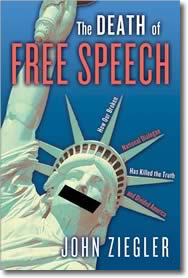
The Death of Free Speech

THE DEATH OF FREE SPEECH
How Our Broken National Dialogue Has Killed the Truth and Divided America

by John Ziegler

In The Death of Free Speech, radio talk-show host and TV commentator John Ziegler examines how the news media has created arbitrary, biased, and illogical rules for determining what can and cannot be said in the public arena. He details how in almost every major case of “speech and punishment” in modern America, the guilty verdict was wrong and unjust.

From incidents involving Jimmy “the Greek,” Trent Lott, and Fuzzy Zoeller to Rush Limbaugh, John Rocker, and Jocelyn Elders, he blows apart the conventional wisdom that led to these public figures being unfairly penalized for expressing their constitutionally protected opinions and explains why others have been spared despite making similar statements. Through his own experiences of being fired for things he has said on-air, as well as never-beforerevealed interactions with others who found themselves the target of the self-appointed “thought police” in the news media, Ziegler takes an in-depth look at the issues that surround these controversies. Ziegler also looks at the increasing corporate conflicts and legal restrictions being imposed on free speech, particularly when it comes to political speech, which came to the forefront of the 2004 election campaign in the battle over the candidates’ Vietnam War records. He scathingly obliterates the news media’s pathetic handling of that issue and describes how it affected the election itself. And he exposes how restrictions on free speech have created a media matrix that makes it impossible for the truth to ever be known by most Americans.

The Death of Free Speech is an objective, credible, provocative, and entertaining look at one of the most important and underreported realities in American society. No one is in better position to tell this story than John Ziegler as he warns that this most cherished constitutional right is in grave jeopardy.

JOHN ZIEGLER is a veteran of the radio and television industries who has been on the air in several major markets including Raleigh, Nashville, Philadelphia, Louisville, and Los Angeles, where he currently is the host of the evening show on the most listened to talk-radio station in the country. He has frequently served as a commentator on local and national television shows and as a columnist for numerous newspapers and prominent political Web sites. He lives in Burbank, California.

$24.95, HARDCOVER
ISBN: 1-58182-441-6

http://www.cumberlandhouse.com/spring2005/deathoffreespeech.asp

Cumberland House Publishing
Celebrating 10 years of Publishing Excellence: 1996-2006

Timeline: A History of Free Speech

David Smith and Luc Torres
Sunday February 5, 2006
The Observer

http://observer.guardian.co.uk/focus/story/0,,1702539,00.html

The following correction was printed in the Observer's For the record column, Sunday February 10 2006

We were muddled to say in the article below that 'the First Amendment of the US Bill of Rights guarantees four freedoms: of religion, speech, the press and the right to assemble'. The first 10 amendments to the US Constitution are collectively known as the Bill of Rights, and there are five, not four, freedoms guaranteed by the First Amendment, the fifth being the right 'to petition the government for a redress of grievances'.


399BC Socrates speaks to jury at his trial: 'If you offered to let me off this time on condition I am not any longer to speak my mind... I should say to you, "Men of Athens, I shall obey the Gods rather than you."'

1215 Magna Carta, wrung from the unwilling King John by his rebellious barons, is signed. It will later be regarded as the cornerstone of liberty in England.

1516 The Education of a Christian Prince by Erasmus. 'In a free state, tongues too should be free.'

1633 Galileo Galilei hauled before the Inquisition after claiming the sun does not revolve around the earth.

1644 'Areopagitica', a pamphlet by the poet John Milton, argues against restrictions of freedom of the press. 'He who destroys a good book, kills reason itself.'

1689 Bill of Rights grants 'freedom of speech in Parliament' after James II is overthrown and William and Mary installed as co-rulers.

1770 Voltaire writes in a letter: 'Monsieur l'abbé, I detest what you write, but I would give my life to make it possible for you to continue to write.'

1789 'The Declaration of the Rights of Man', a fundamental document of the French Revolution, provides for freedom of speech .

1791 The First Amend-ment of the US Bill of Rights guarantees four freedoms: of religion, speech, the press and the right to assemble.

1859 'On Liberty', an essay by the philosopher John Stuart Mill, argues for toleration and individuality. 'If any opinion is compelled to silence, that opinion may, for aught we can certainly know, be true. To deny this is to assume our own infallibility.'

1859 On the Origin of Species, by Charles Darwin, expounds the theory of natural selection. TH Huxley publicly defends Darwin against religious fundamentalists.

1929 Justice Oliver Wendell Holmes, of the US Supreme Court, outlines his belief in free speech: 'The principle of free thought is not free thought for those who agree with us but freedom for the thought we hate.'

1948 The Universal Declaration of Human Rights is adopted virtually unanimously by the UN General Assembly. It urges member nations to promote human, civil, economic and social rights, including freedom of expression and religion.

1958 Two Concepts of Liberty, by Isaiah Berlin, identifies negative liberty as an absence or lack of impediments, obstacles or coercion, as distinct from positive liberty (self-mastery and the presence of conditions for freedom).

1960 After a trial at Old Bailey, Penguin wins the right to publish D H Lawrence's sexually explicit novel, Lady Chatterley's Lover.

1962 One Day In the Life of Ivan Denisovich by Aleksandr Solzhenitsyn describes life in a labour camp during Stalin's era. Solzhenitsyn is exiled in 1974.

1989 Iranian leader Ayatollah Khomeini issues a fatwa against Salman Rushdie over the 'blasphemous' content of his novel, The Satanic Verses. The fatwa is lifted in 1998.

1992 In Manufacturing Consent, Noam Chomsky points out: 'Goebbels was in favour of free speech for views he liked. So was Stalin. If you're in favour of free speech, then you're in favour of freedom of speech precisely for views you despise.'

2001 In the wake of 9/11, the Patriot Act gives the US government new powers to investigate individuals suspected of being a threat, raising fears for civil liberties.

2002 Nigerian journalist Isioma Daniel incenses Muslims by writing about the Prophet Mohammed and Miss World, provoking riots which leave more than 200 dead.

2004 Dutch film maker Theo van Gogh is killed after release of his movie about violence against women in Islamic societies.

2005 The Serious Organised Crime and Police Act bans protest without permit within 1km of the British Parliament.

Related articles

03.02.2006: Jack Straw praises UK media's 'sensitivity' over cartoons
03.02.2006: Norwegian editor apologises
03.02.2006: Jordanian editor sacked over cartoons
03.02.2006: Danish paper regrets publishing cartoons
03.02.2006: UK press hold back in cartoon row
03.02.2006: What the papers say
03.02.2006: European elite scrambles to defuse furore
02.02.2006: BBC joins cartoon controversy
02.02.2006: Spectator makes cartoon U-turn
02.02.2006: Cartoons published in Jordan
02.02.2006: Palestinian gunmen in cartoons protest
01.02.2006: Bomb threat to repentant Danish paper
01.02.2006: Cartoon row spreads across Europe
31.01.2006: Danish paper sorry for Muhammad cartoons
Read the apology
30.01.2006: Danish paper sparks angry protests

Comment
03.02.2006: Leader: Cartoons and their context
03.02.2006: Sarah Joseph: The freedom that hurts us
02.02.2006: Prophetic fallacy
03.02.2006: Letters: Muhammad and the limits of free speech

MediaGuardian.co.uk special report
Race and the media

Friday, October 27, 2006

What about the White House Role in selling out our South Capitol Mall with this idiotic baseball stadium?

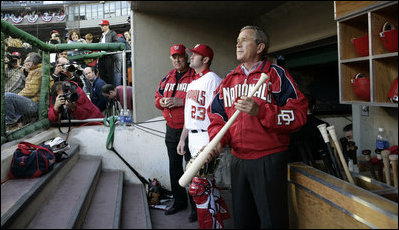
My guess about the arbitrary 2008 deadline has a competing hypothesis: that it is to provide George Walker Bush, who has long been involved with Major League Baseball, the opportunity to get to throw out the first ball at the Nationals Stadium’s opening game, while he is still U.S. President.


After all, getting to throw out that 1st ball has been a customary ritual of U.S. Presidents since April 14, 1909, with U.S. President William Howard Taft.


Since George Walker Bush’s current term ends January 20, 2009, 2 months prior to the start of the 2009 baseball season, and that he is barred from a 3rd term, his last opportunity for so inaugurating monstrosity stadium is the start of the season of 2008.


Why not at least simply let him have the honor as a former President in 2009 or 2010, and save the D.C. government some of the money and hassle of this burdensome stadium contract?

It’s interesting how the White House seems to be getting away with creating an entity that can be used to subvert the 1st Amendment, including potentially by the White House, but which can’t be subpoenaed to conduct discovery upon the chain of investigation to establish political motives in a court of law.

Perhaps there was some agreement made – unreported by the mass media – between Republican party operatives and Roman Catholic Church hierarchy around 2000, to get a large massive object of a baseball stadium placed to extend St. Vincent de Paul Church’s building line southward, while giving George Walker Bush monstrosity stadium’s first throw of the ball.

http://www.iconbusters.com/iconbusters/htm/photo_album/1/71-figure.htm

Note Bush's facial expression: might he have been thinking something like: "Golly; I get to throw the first ball in the new stadium"?


Rough outline of stadium garages conflict
with the U.S. National Capitol Planning Commission's
South Capitol Street Frederick Douglass Mall

If anyone was establishing a U.S. Department of Homeland Security consciously as a means of silencing dissent, such entities are logical subjects for questioning over the chain of command leading to government ambushing its own citizens.


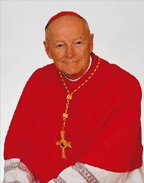
And what about Washington Archbishop Theordore McCarrick (retired May 2006) and/or his successor and from below or above?

Theodore E. McCarrick

McCarrick's successor's biography:
http://www.adw.org/about/lead_bio_wuerl.asp

Did either of these men “press the button” on me through U.S. Department of Homeland Security?

I don’t know, one way or the other.

What I do know:

That they are not the only people within the Roman Catholic Church hierarchy. Perhaps it was done by others within that hierarchy at some level or another, perhaps even from Rome? Or perhaps at a lower level?

That it is a Roman Catholic Church at the northeast corner of South Capitol and M Streets in Washington, D.C. – St. Vincent De Paul Church -- that is the most architecturally significant building along that north south corridor to the south of the SW/SE Freeway;

That there has been nothing in the media that I have found about any negotiations that occurred between government and Roman Catholic Church hierarchy regarding that Church’s future, nor the conflict with National Capitol Planning Commission’s Extending the Legacy: Planning America's Capital for the 21st Century South Capitol Street Frederick Douglass Mall.

That Theodore McCarrick appears on the list of Catholic University of America Board of Trustees, along with Mark Tuohey, Chairman of the D.C. Sports and Entertainment Commission. I know this from researching them via the internet, aka finding their names on the CUA web site, though I am not aware of any journalist accounts mentioning, let alone discussing, this.

http://publicaffairs.cua.edu/factbook/trustees.htm

It's a list that does not include McCarrick's sucessor Wuerl, but which does include New York Cardinal Eagin.

I have not seen either the names of Wuerl nor Eagin appear in anything regarding the Washington Nationals.

I do not know McCarrick’s exact role in the affairs regarding the Washington Nationals and their atrociously placed Stadium. But his name does appear with Tuohey and a list of figures staring with Condoleezza Rice, in that September 18, 2005 article in The Washington Times of wealthy baseball backers.

“It’s all about building relationships.” Mr. Tuohey said one humid night in his large suite, where he has entertained guests from Capitol Hill as well as Cardinal Theodore McCarrick and Eddie Johnson, coach of the Wizards. “is this a good place to do that? The answer is yes.”

http://www.washingtontimes.com/familytimes/20050917-104942-2368r.htm
Who were these "guests from Capitol Hill? The Washington Times article fails to say.

The placement of Nationals Stadium obviously essentially extends the building line of St. Vincent De Paul Church southward, blocking off the eastern half of the South Capitol Mall.


Was perhaps Theodore Lerner’s placement of his 20 M Street project a favor to McCarrick to buttress St. Vincent de Paul Church’s existing placement, perhaps so that McCarrick could use his influence to have Lerner “selected” as the owner of the Nationals? Or was this just a coincidence?

Who knows?

And what about the acquiescence of the U.S. government?

Why no accounting to the public of the identities of the government officials that sold out our South Capitol Mall?

“Severely Vindictive Nature” of RCC Hierarchy as described by those within the RCC

My recent time-line suggestive of an illegal use of U.S. Department of Homeland Security as revenge for internet writings questioning the role of Roman Catholic Church hierarchy with killing the South Capitol Mall, perks my reaction to the October 11, 2006 posting in a blog “Wispers in the Loggia” of a letter calling for the resignation of New York Archbishop Edward Egan:

October 2006

Dear Brother Priest:

A Committee of Concerned Clergy for the Archdiocese of New York has met to discuss the critical condition of the Archdiocese of New York. As you would understand, because of the severely vindictive nature of Cardinal Egan,this committee must remain anonymous. This letter is being sent to many priests throughout the Archdiocese so that at each Vicariate meeting a formal vote of “NO Confidence” can be exercised with regard to Cardinal Edward Egan in his role as Archbishop of New York. As you know, the collective memory of the presbyterate cannot recall a time in recent history when the morale of priests has been so broken and low. Some of our elderly priests can well recall the Cardinal Spellman years. Many remember the tenure of Cardinal Cooke and certainly everyone remembers Cardinal O’Connor. At no time has the relationship between the Ordinary and the priests of the Archdiocese been so fractured and seemingly hopeless as it is now.

Since his arrival in New York, the Cardinal has given his time, attention and interest to matters financial while paying little or no attention to the spiritual needs and concerns of the priests and faithful of the Archdiocese. During the last six years the Priests of the Archdiocese of New York have been patient, understanding, tolerant and loyal. Several attempts have been made to open avenues of communication with the Cardinal but to avail. During the last six years, the Cardinal’s relations with the Priests of New York have been defined by dishonesty, deception, disinterest and disregard. Far too many of our brothers can speak personally of the arrogant and cavalier manner in which they have been treated by the Cardinal. Early in his tenure, the cruel and ruthless way in which several priests who served on the seminary faculty were dismissed, was an adumbration of how many other priests would also be treated. Time and again, the Cardinal fails to be the Father that every bishop must be to his priests.

With regard to important policies and decisions that impact upon the welfare of the Archdiocese, it is evident that the Cardinal does not seek advice or counsel from the many competent and experienced priests who so faithfully serve as pastors and members of his chancery staff. Instead, it is regrettably and seemingly apparent that the Cardinal relies on the advice of his priest-secretary [Msgr Gregory Mustaciuolo] who enjoys a most limited and meager pastoral experience.

The Fifth Anniversary of September 11th was a sad reminder of the Cardinal’s decision to leave New York only two days after the attack, during a time when the city desperately needed a spiritual leader. How sad, painful and disappointing it was to hear the tabloids referring to the then Mayor Giuliani as the “Shepherd of the City”. Since that time, the Cardinal has continued to fail in his role as Shepherd. Pope John Paul II referred to New York as the Capital of the World. How unfortunate it is that the voice of the Archbishop of New York is almost never heard in that “Capital”. The Cardinal demonstrates an unnatural fear of the media and he forfeits the great opportunity to employ the media as a means of addressing the many contemporary questions of faith and morals. It is unthinkable that in this millennium a Successor to the Apostles would shrink from such a valuable opportunity for evangelization and hide himself within the walls of his residence.

Sadly, it is evident that this Cardinal is unable to deal with the complexities, problems and challenges of an Archdiocese of the magnitude and diversity of New York. For these reasons and more, the Priests of the Archdiocese of New York must express a vote of NO CONFIDENCE. Such a vote would encourage the Papal Nuncio and the Holy Father to strongly consider accepting the Cardinal’s resignation in April,2007, when he reaches the age of retirement, rather than at a future and uncertain date before his 80th birthday, as can often be the case with retiring Cardinals. The search for a new Archbishop should begin sooner rather than later. Rome must know that the priests and people of New York desperately need a Bishop who will be “strong, loving and wise” (II Timothy: 1:7): a Bishop who will love his priests, seeing them as his spiritual sons and faithful assistants: a Bishop who will begin the healing that is so desperately needed in this Archdiocese: a Bishop who will preach and teach without fear of seeing his name in a newspaper: a Bishop who will truly see holiness in Truth.

The Committee suggests that at each vicariate meeting a secret ballot be taken in which each priest who is present could vote. It was thought that only priests and no deacons should participate in this vote. The votes should be counted at that meeting and the tally registered on the enclosed form. The form should be signed by two witnesses and a copy sent to each of the Vicars General. It would be incumbent upon the Vicars General to report the vote to the Papal Nuncio. At this important and critical moment, let us move forward with prayerful courage.

After prayeful consideration, I cast my vote as:

NO CONFIDENCE in Cardinal Egan: _____

CONFIDENCE in Cardinal Egan:_____

ABSTENTION: ______

------------------------------------------------------------------------


Each Vicariate should send a copy of this form to each of the Vicars General-


Vicariate: ____________________________

Date of Meeting:________________________

Number of Priests in attendance: ____________

Number voting - NO CONFIDENCE: __________

Number voting – CONFIDENCE: _____________

Number voting – ABSTENTION: _____________


These vote was taken and counted in the presence of all those in attendance at the Vicariate meeting.
Witnessed by:

___________________ __________________

http://whispersintheloggia.blogspot.com/2006_10_01_archive.html

“… because of the severely vindictive nature of Cardinal Egan, this committee must remain anonymous …”

Indeed. From my perspective, look what happens to someone who uses his real name!

So we are to become a nation of people afraid to link their names to their writings, lest some powerful well connected entity get to sic the U.S. Department of Homeland Security on them with warrant less searches of any electronically stored data.

The U.S. Department of Homeland Security surely is an effective means to potentially render the general citizenry as blackmail able as a career politician.

This will especially be felt later for those born into the internet age. Just imagine having everything you’ve written accessible forever because you typed it into an electronic device- email, IM, web sites, search engines, on line dating and pornography services, anything.

Vindictiveness of RCC in the electronic age of US Department of Homeland Security

2006 Timeline:

February 5, 2006

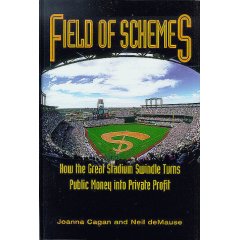
I make a private email to an internet writer of stadium issues, Neil De Mause, of Fields of Schemes, questioning “certain institutions” for mucking up the planning of our Nation’s Capital for greed.

March 8, 2006

I begin receiving email from Verio, my internet service provider for my web sites
http://www.HIghwaysAndCommunities.com and http://www.HIghwaysAndCommunities.com/southcapitolstreet
with an invoice problem upping my $29.95 monthly charge to $599.00

March 17, 2006

I made a public post questioning the role of the Roman Catholic Church in the planning for South Capitol Street in response to a misleading post by Neil De Mause on yahoo.stadiums.newsgroups.

--- stadiums@yahoogroups.com wrote: > 6.
Field of Schemes Update: D.C. development> to lag behind stadium> From:
neil@demause.net> > Message: 6
Date: 17 Mar 2006 15:48:46 -0000 From:
neil@demause.netSubject: Field of Schemes

Update: D.C. development to lag behind stadium (snip)

Before condos are built and stores opened, major transportation improvements are necessary, including a $20 million renovation of the Navy Yard Metro station.The D.C. Department of Transportation is about to spend $625 million to expand South Capitol Street and rebuild the Frederick Douglass Bridge.---

Neil: South Capitol Street is to be
"expanded"???

This is news to me as every report that I have seen shows theplanners retaining the existing narrow (30') streetright of way width, as I have pointed out to you and others with my web site on that area's planning at: http://www.HighwaysAndCommunities.com

That planning decision was ostensibly done to save dwellings to the west of South Capitol Street; however these are shown removed and replaced by much larger buildings in National Capitol Planning Commission’s2005 report. That decision will deny any linear greenway for South Capitol Street; it will complicate if not stop the Anacostia Waterfront Initiative plans for a parallel vehicular tunnel.

That decisions’ primary beneficiary are the owners of the one and only significant building along this corridor that will survive the redevelopment: the Archdiocese of Washington's St. Paul de Vincent Church at the northeast quadrant of South Capitol and M Streets.

http://www.highwaysandcommunities.com/southcapitolstreet/South_Capitol_Street_Question_of_St_Vincents_Church.htm

Note that in my interpretation of the Legacy greenway concept, that I have that Church structure retained at its historic context at this intersection, with itsstructure shifted several hundred feet to the east to accommodate the greenway and tunnel. Stuff like this has already been done: in 1969 the oldest Jewish synagogue was moved 5 blocks to accommodate WMATAsubway construction.

Here's something I would like your help on. In the past, where there have been such conflicts, one can find newspaper articles, such as the D.C. I-395 routing north of K Street that is curved to avoid the Bibleway Church on New Jersey Avenue, and the aborted1960 plans to route I-95 into D.C. through the Catholic Sisters properties. But I can not find a single newspaper article on the role of the Roman Catholic Church authorities in the planning for the South Capitol Street, even though I have been told by fellow attendees at the National Building Museum that individuals from the Archdioceseof Washington, did express their absolute opposition to any moving of the St. Vincent De Paul Church structure.

Could you and any one else, please indicate what news accounts exist about this. It would definitely make an excellent and extremely appropriate story for a Neil de Mause Field's of Schemes write-up.

Cheers

Douglas A. Willinger
http://www.HighwaysAndCommunities.com/southcapitolstreet
(the web site about the botching of the planning forSouth
Capitol Street)

That received no reply; to the best of my knowledge, Neil de Mause has yet to write any such story either in stadiums@yahoo.groups, nor in his Field of Schemes web site. I find this notable since de Mause had contacted me hours after my initial September 2004 internet posts about the stadium blocking the South Mall, expressing interest in this story.


March 28, 2006

My “PATRIOT” Act - U.S. Department of Security ID-financial file is checked out by someone (I don’t know who). I found this out upon opening a bank account recently.

“PATRIOT” may mean “Pry And Treat Roughly In Our Turf”?

March 29, 2006

I start my blog http://wwwsouthcapitolstreet.blogspot.com with the post Choices.”

Strange automobiles begin appearing in my family’s house driveway; we (my Mother and myself) have seen what appear to be airport taxi (un-stretched limo) pulled all the way down the driveway, past the sidewalk to the front door where he could be seen from inside the house, to a blind spot next to the garage doors and operating a lap top computer; my mother goes out to inquire, the driver says he is looking for “Mr. Brown” and speeds off.

This is the first happening of this in 6 years at that address, and such misplaced automobiles begin to show up intermittingly through Spring and into the Summer.

April – July 2006

I make numerous posts about the South Capitol Street corridor planning, with some of these mentioning the St. Vincent de Paul Church.

July 22, 2006

At 11.11 AM, I make a post “Physical Realities”.

It shows the St. Vincent DePaul Roman Catholic Church and the new office building going up behind it at 20 M Street SE preventing the church building’s easiest relocation, owned by the man who was selected to purchase the Washington Nationals baseball franchise, juxtapositioned with the man over the St. Vincent de Paul Church, Theodore Lerner and Theodore McCarrick.

5 hours later, my mother opens and steps outside the front door and sees a strange automobile stopping in front, with the driver staring and pointing directly at our house; he speeds off.

(The house is on a dead end street, making it easier to notice such vehicles).

This was not a daily experience during the blog’s 4 month, 6 day duration of posts. But it became an occurrence shortly after whenever I made a post spot lighting St. Vincent de Paul Church.

The ambush itself occurred at about 2:30 AM, August 5, 2006.

Because of the timing of things, including my blog’s post of July 22, 2006 “Physical Realities” which includes a photo of Washington Cardinal Theodore McCarrick (who retired May 2006), and the simple fact that St. Vincent de Paul Church is a Roman Catholic Church, this suggests to me that the entity that I have pissed off is the Roman Catholic Church.

The fact that no one else touches this South Capitol Mall issue – that it has gone entirely unreported by the “mainstream” media as if the issue was taboo to report or discuss -- adds to this outlook. So does the following.

The Total Lack of Media Coverage of this Church-Mall conflict

This blogger can’t find a single mass media news report of anything regarding a possible opposition by Roman Catholic Church officials to moving St. Vincent de Paul Church, nor a decision to accede to such a position.

All of the newspaper reports about the South Capitol Street re-development somehow get around even mentioning St. Vincent de Paul Church despite it being by far that corridor’s nicest building. Remarkably this includes both The Washington Post and The Washington Times.

This lack of media coverage differs from previous such instances of conflicts which the newspapers did report. I found these examples in my work as public internet historian of Washington, D.C.’s un-built highways as creator of the Takoma Park Highway Design Studio web site at
http://www.HighwaysAndCommuities.com.

Two such examples involve different segments of I-95 through Washington, D.C.: its northernmost segment from the 1960 engineering study’s proposed route through Catholic Sisters College, and the downtown Center Leg’s routing north of K Street in the vicinity of New Jersey and New York Avenue, re-designed with a tunneled curve to the northwest to avoid the Bibleway Church.

1960 I-95 Northeast Freeway at Catholic Sisters

I-95 (I-395) curve to avoid Bibleway Church

Although I could easily see this reason for this curve, I found newspaper accounts of public pleas from named people at Bibleway Church confirming his, as I did with that regarding Catholic Sisters College. Both The Washington Post and The Washington Star (which ended publication in 1981, one year prior to the 1982 introduction of The Washington Times) did their expected jobs, unlike later with the non-reporting of the South Capitol Mall, its opposition and demise.