Showing posts with label constitutional subversion. Show all posts

Thursday, December 13, 2007

APSU mock trial rules President Bush “guilty” of illegal domestic surveillance


Verdicts are in on the two day mock trial, U.S. vs. Bush. Bush was found guilty on the charges relating to illegal and unauthorized domestic surveillance and wiretapping of American citizens and violating the Separation of Powers and FISA by ordering a secret Executive Order authorizing such action.

More...

co-three-defense-attorney-dr-rabidoux-3-prosecutor-5-judges.JPG

Standing from left: Lead Defense, Jessica Lance, Frankie A. DeJesus and Matt Harris, APSU Professor Dr. Rabidoux,; Lead Prosecutors Michael Hughey, Mike Price and Liz Borsavage. The Judges, seated from left, Kasey Henricks, Emery Walters, Enderson Miranda, Ryan Knight and Zach Suggs

Tuesday, November 20, 2007

Something to Hide

President Bush, right, greets new Attorney General Michael Mukasey, center, at the conclusion of a ceremonial swearing-in, Wednesday, Nov. 14, 2007,at the Justice Department in Washington. Chief Justice John Roberts is at center. (AP Photo/Gerald Herbert)

From an op ed piece in The New York Times by Nicholas deB. Katzenbach, U.S. attorney general from 1965 to 1966, and Frederick A. O. Schwarz Jr. senior counsel at the Brennan Center for Justice at New York University.

RELEASE JUSTICE'S SECRETS

When the Justice Department, usually acting through its Office of Legal Counsel, issues legal opinions binding on the executive branch, there is never justification for keeping them secret. Opinions that narrowly define what constitutes torture; or open the door to sending prisoners for questioning to Egypt and Syria, which regularly use torture; or rule the president has some “inherent power” to ignore laws are all of concern to Congress and the public whether one agrees or disagrees with the legal analysis.

Yet all these opinions have been kept secret, along with many other, related post-9/11 opinions that purport to decide what America’s law is.

Secrecy always increases the risk of foolish mistakes. If the withheld opinions are sound, why fear letting them see the light of day? Is there ever a justification in a government of law for keeping what one believes to be the law secret?

Some may say releasing the opinions will lead to more embarrassment. To this, there are two answers. First, what is most important is that we get it right and remain true to our country’s values. Second, the best way to restore our reputation is to confront our mistakes openly and then resolve not to repeat them.

Foolish mistakes as subverting the values of the 1st Amendment of the U.S. Constitution by targeting internet writers via criminal warrantless surveillance and law enforcement- particularly upon a time line suggesting the culprits as President George W. Bush and his masters at the Vatican.

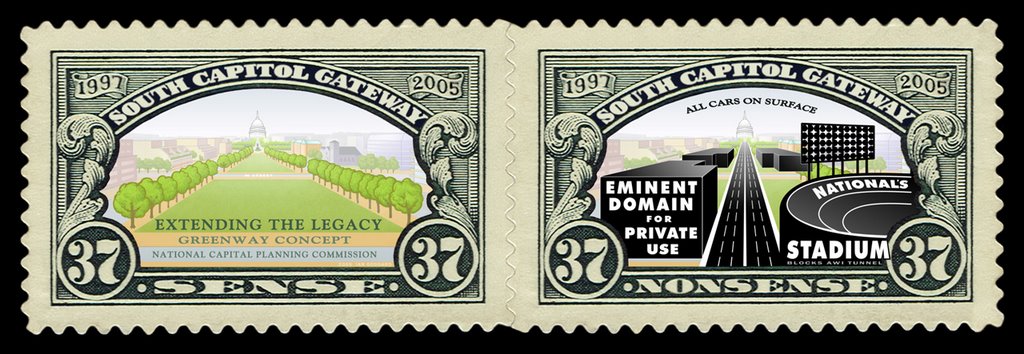
U.S. National Capital Planning Commission's aborted South Capitol Mall

Washington Cardinal Archbishop Theodore Mc Carrick (2000-2006)

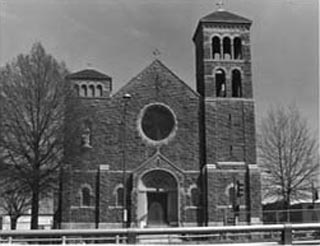
St. Vincent de Paul Church- the sole building along South Capitol Street saved by the South Capitol Mall's cancellation

Mark Tuohey of the DC Sports and Entertainment Commission, who sat on the Board of Trustees of Catholic University with McCarrick, and upon that of Gonzaga HS and Washington Jesuit Academy


The 2002 stadium study indicating St Vincent de Paul Church as the sole surviving building on the east side of this stretch of South Capitol StreetMajor League Baseball: the entity that insisted upon cramming this stadium along South Capitol Street, by making the specific location a condition of allowing the establishment of the Washington Nationals franchise

2008 is the last year he can throw the 1st ball as U.S. President
More on this custom of the U.S. President throwing the 1st ball:
http://www.whitehouse.gov/baseball/

"W" Stadium

Blogger Douglas A. Willinger Ambushed, Arrested (while carrying his Verizon cell phone)

Friday, October 26, 2007

TelCon Treason: Motorola to Hire Retiring DEA Head Karen Tandy


Considering a Motorola cell phone? Then consider the following:

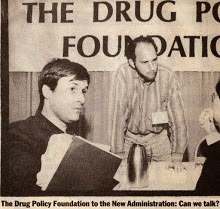
From Stop the Drug War:
http://stopthedrugwar.org/chronicle_blog/2007/oct/22/dea_director_resigns_says_she_ha#comment-6773

DEA Administrator Karen Tandy announced her resignation today, marking her 4-year tenure with another trademark Tandyism:

"It just doesn't get any better than this," Tandy said in a statement about her time at DEA. [Washington Post]

Well, at least somebody had a good time. Now Tandy is moving into the telecom industry:

Tandy told employees she was leaving to take a job as a senior vice president of Motorola, DEA spokesman Garrison Courtney said. Motorola is a leading sponsor of a DEA traveling museum exhibit about global drug trafficking and terrorism…

Did you guys hear that? Motorola is a major private funder of insidious drug war propaganda and decorates its highest offices with exhausted anti-drug soldiers. Let's all make a mental note of how socially conscious this company is.

And let's all note her likely work in assisting the government with criminal wire-taping of telecommunications, given her background at the U.S. Drug Enforcement Agency (in market protection for pharmaceuticals, alcohol and Tobacco- a scheme that betrays the public health by manufacturing its own justification by shifting markets from safer plants to far, far, far more dangerous concentrated refined substances).

Add Motorola to the boycott against Verizon and other telcon traitors.


Monday, October 22, 2007

Verizon Bribes U.S. Senator Rockefellor for TelCom Immunity

A trio of men in need of arrest and prosecution for involvement with bribery for Constitutional subversion, to wit the 1st and 4th Amendments:

For offering a bribe:
Verizon CEO Ivan Seidenberg
Chairman and CEO ($19,425,000 annual compensation 2005),
Executive VP and President and CEO of Verizon Wireless CEO Dennis Strigl
($11,209,600 annual compensation 2005)
For receiving a bribe:
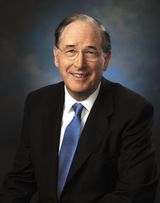
U.S. Senator Jay Rockefeller.

From http://kipesquire.powerblogs.com/posts/1192978834.shtml
Verizon & AT&T Buy a Senator (and Possibly NSA Immunity)

While one moral defective gets caught with her campaign contribution hand in the Chinatown fortune cookie jar, another moral defective gets caught with his votes-for-sale hand on the wiretapped telephone:
Senator Jay Rockefeller (D-West Virginia) is reportedly steering the secretive Senate Intelligence Committee to give retroactive immunity to telecoms that helped the government secretly spy on Americans.

He has also recently benefited from some interesting political contributions.

Top Verizon executives, including CEO Ivan Seidenberg and President Dennis Strigl, wrote personal checks to Rockefeller totaling $23,500 in March, 2007. Prior to that apparently coordinated flurry of 29 donations, only one of those executives had ever donated to Rockefeller (at least while working for Verizon).
More interesting facts:

--The Verizon donations all occurred in a single month: March 2007. Curious.

--Almost all the AT&T donations occurred on two single days: May 22, 2007, and June 1, 2007. Curiouser.

--Rockefeller, despite being worth over $100 million, actually needs the money, having "selflessly" pledged to spend none of his own fortune for his 2008 re-election campaign (in "very red" Red State West Virginia).

--The flood of telco executive donations to Rockefeller only began after the Democrats took control of the Senate; as one commenter notes, "It doesn't make sense to bribe a member of the minority party, does it?"

Meanwhile, Rockefeller's Senate Intelligence Committee passed the "telco immunity" version of the warrantless wiretapping authorization. Further hurdles await in the Senate Judiciary Committee and in the House. Let's see how much more telco cash finds it way into politicians' pockets.
Having been targeted by law enforcement while carrying a Verizon cell phone registered in my name as apparent revenge for my blog questioning the Vatican role in the U.S. government aborting its South Capitol Mall, and in the planning of the Washington Nationals Stadium, I do believe that Verizon knows that it violated the U.S. constitution.

Sunday, September 16, 2007

NY Times editorial:The Wrong Balance

The Wrong Balance on Civil Liberties

Following the dastardly attacks of 9/11, it was evident that the nation had to do some careful thinking about the proper balance between national security and civil liberties. Instead of care and balance, sadly, the Bush administration immediately lunged to claim extraordinary, and largely unnecessary, new powers. Aided by a compliant Congress, the administration repeatedly tried to shield the resulting intrusions on people’s rights from meaningful scrutiny, even by the courts.

Recently, however, a federal district judge in New York declared unconstitutional one notorious outgrowth of the Bush team’s approach: the Federal Bureau of Investigation’s overreliance on informal demands for information, called national security letters, to obtain private records from telephone and Internet companies, banks and other businesses without a court warrant.

The decision by Judge Victor Marrero struck down 2006 revisions to the Patriot Act that expanded the bureau’s power to use national security letters, and a 1986 law that first authorized such letters. The recent provisions not only compelled companies to turn over customers’ records without a warrant, but forbade them to tell anyone what they had done, including the customers involved. The authority of the courts to review challenges to the gag rule was extremely limited.

Judge Marrero took proper umbrage at the attempt to tightly confine the courts’ authority and to silence recipients of national security letters without meaningful judicial review. He declared that the measure violated both the First Amendment and the principle of separation of powers. The deference that the law required courts to give to the executive branch, he stated, could amount to “the hijacking of constitutional values.”

This was not the first time the courts had tried to curtail this new power. Judge Marrero enjoined an earlier version of the law in 2004, and a federal judge in Connecticut did the same in 2005. But Congress, which was still under Republican control, responded with changes that only created additional constitutional flaws.

In the absence of oversight, the number of surveillance letters has mushroomed, and so have the abuses. A report issued last March by the Justice Department’s inspector general found that between 2003 and 2005, the F.B.I. issued an astonishing 143,000 requests using the letters, often in violation of the bureau’s own regulations, and sometimes in violation of the law. Three days after Judge Marrero’s ruling, Eric Lichtblau reported in The Times that the F.B.I. used the secret letters to obtain information not only on individuals it viewed as targets but also on people who came in contact with the targets.

Lawmakers in both parties have voiced disapproval of the F.B.I.’s abuse of national security letters. But they have not made a sustained push to fix the law that created this mess. Judge Marrero’s ruling should change that.


David Addington: Another Eichmann?

David Addington
Found in The Next Hurrah:

The Banality of the Unitary Executive

Except relating to one thing. David Addington. By far the biggest surprise to me, in terms of personal impressions, is David Addington.

As I've been reminding at every opportunity, David Addington is Mr. Unitary Executive, the guy who has provided legal justification for many of Cheney's biggest power grabs: torture, extraordinary rendition, domestic spying, and so on.

I truly expected his interviews to be terribly hostile. I truly expected to see Addington bristle at every question. But that didn't happen.

To me, David Addington has all the mannerisms and look of a physics or computer science professor. He has the beard of a professor, [a Jesuit professor] the modest (at least looking) suit, and he's kind of big-shouldered.

I found his response to questions even more interesting. He simply answered them, with no hesitation. He was apt to offer up information rather than hold it back. He would wander on and on, explaining all the details surrounding something (I remember his description of various classifications, for example, as this long conversation, "and then ... and then ... and then"). He is so obviously steeped in this world and these regulations that he just holds forth on them, with almost no filter.

And there seemed to be no effort to protect Libby--or even Cheney. This became most clear when Fitzgerald started talking about the document on which Cheney mentioned Bush (then crossed it out). Fitzgerald's point was that OVP had stamped a classification that is not really a classification on these documents--Treated as Top Secret/SCI--that is, as Addington explained, not really a classification, "treated as." Pretty damning stuff, catching Cheney and Libby protecting their own deliberations by classifying the hell out of them, inventing new classifications.

And Addington just described this as he had everything else, wandering on in a seemingly endless mumble. He showed no hint of trying to hide this information, no hint of embarrassment that the guy who is, after all, still his boss was trying to pull a fast one to protect his own actions.

Not what I expected.
A response:

While you're doing a great job with the blogging, it's nice to have you back thinking. Your surprise at Addington's persona came through in your trial narrative. It made me think of a book I read a long time ago [name blowing in the wind]. It was about the long interrogation of Adolf Eichmann. His interrogator was determined to get at the root of his hatefilled antisemitism. Instead, what he found was an emotionally blunted obsessive compulsive who was worried about meeting production deadlines - without much registering that what he was producing was murdered human beings. In Eichmann's trial, his "sole defense was claiming that he had been a petty government functionary, merely following the orders of superiors." [Wikipedia] That's probably a tragic truth.

That's how Addington sounded to me - caught up in the precise details and legalese but emotionally isolated from the impact of his pronouncements on the country. He seemed to light up slightly when he went on and on about procedures, or definitions. I suspect he reads the Dictionary in the shade when he goes to the beach.

So I wasn't so taken with his Narcissism as some of the other commentors. I thought he was more the obsessive sidekick of that Megalomaniac he works for whose emotional range only goes from "none" to "contempt" and back again [you know, the one on Blitzer's Situation Room the other day]...

Posted by: mickey | January 31, 2007 at 19:38


Added: September 12, 2009:
http://en.wikipedia.org/wiki/David_Addington

(excerpt)

Addington graduated from Sandia High School in Albuquerque, New Mexico in 1974. He was admitted to United States Naval Academy at Annapolis and attended beginning in Fall 1974, but did not graduate. He is a graduate of the Edmund A. Walsh School of Foreign Service at Georgetown University (B.S.F.S., summa cum laude) and holds a J.D. (with honors) from Duke University School of Law.[7] He was admitted to the bar in 1981.


Monday, August 27, 2007

Gonzales Resigns- One Down, XXXX to go

U.S. Attorney General Alberto Gonzales submits his resignation effective September 17, 2007.

http://www.truthout.org/docs_2006/082707Z.shtml


His resignation does nothing substantial -- except serve as a distraction -- as long as the influence of the counter reformation (religious terrorist) entity of Georgetown University which produced the so-called PATRIOT Act -- remains unchallenged.

Sunday, July 29, 2007

Bush-Gonzales Surveillance Scandal Cover Up

The New York Time guesses correctly, even while failing to consider any such possible instances involving subverting the 1st Amendment.

New York Times editorial:

President Bush often insists he has to be the decider — ignoring Congress and the public when it comes to the tough matters on war, terrorism and torture, even deciding whether an ordinary man in Florida should be allowed to let his wife die with dignity. Apparently that burden does not apply to the functioning of one of the most vital government agencies, the Justice Department.

Americans have been waiting months for Mr. Bush to fire Attorney General Alberto Gonzales, who long ago proved that he was incompetent and more recently has proved that he can’t tell the truth. Mr. Bush refused to fire him after it was clear Mr. Gonzales lied about his role in the political purge of nine federal prosecutors. And he is still refusing to do so — even after testimony by the F.B.I. director, Robert Mueller, that suggests that Mr. Gonzales either lied to Congress about Mr. Bush’s warrantless wiretapping operation or at the very least twisted the truth so badly that it amounts to the same thing.

Mr. Gonzales has now told Congress twice that there was no dissent in the government about Mr. Bush’s decision to authorize the National Security Agency to spy on Americans’ international calls and e-mails without obtaining the legally required warrant. Mr. Mueller and James Comey, a former deputy attorney general, say that is not true. Not only was there disagreement, but they also say that they almost resigned over the dispute.

Both men say that in March 2004 — when Mr. Gonzales was still the White House counsel — the Justice Department refused to endorse a continuation of the wiretapping program because it was illegal. (Mr. Comey was running the department temporarily because Attorney General John Ashcroft had emergency surgery.) Unwilling to accept that conclusion, Vice President Dick Cheney sent Mr. Gonzales and another official to Mr. Ashcroft’s hospital room to get him to approve the wiretapping.

Mr. Comey and Mr. Mueller intercepted the White House team, and they say they watched as a groggy Mr. Ashcroft refused to sign off on the wiretapping and told the White House officials to leave. Mr. Comey said the White House later modified the eavesdropping program enough for the Justice Department to sign off.

Last week, Mr. Gonzales denied that account. He told the Senate Judiciary Committee the dispute was not about the wiretapping operation but was over “other intelligence activities.” He declined to say what those were.

Lawmakers who have been briefed on the administration’s activities said the dispute was about the one eavesdropping program that has been disclosed. So did Mr. Comey. And so did Mr. Mueller, most recently on Thursday in a House hearing. He said he had kept notes.

That was plain enough. It confirmed what most people long ago concluded: that Mr. Gonzales is more concerned about doing political-damage control for Mr. Bush — in this case insisting that there was never a Justice Department objection to a clearly illegal program — than in doing his duty. But the White House continued to defend him.

As far as we can tell, there are three possible explanations for Mr. Gonzales’s talk about a dispute over other — unspecified — intelligence activities. One, he lied to Congress. Two, he used a bureaucratic dodge to mislead lawmakers and the public: the spying program was modified after Mr. Ashcroft refused to endorse it, which made it “different” from the one Mr. Bush has acknowledged. The third is that there was more wiretapping than has been disclosed, perhaps even purely domestic wiretapping, and Mr. Gonzales is helping Mr. Bush cover it up.

Democratic lawmakers are asking for a special prosecutor to look into Mr. Gonzales’s words and deeds. Solicitor General Paul Clement has a last chance to show that the Justice Department is still minimally functional by fulfilling that request.

If that does not happen, Congress should impeach Mr. Gonzales.

The domestic criminal law enforcement surveillance leading to my August 5, 2006 ambush occurred only 2 weeks after making this post spot-lighting the masters of the two most important buildings on Washington, D.C.'s South Capitol Street, one day after this other post which speculates about the insistence of this stadium's completion by the start of the baseball season of 2008 .

Please do recall the logical -- yet unreported by the lamestream media -- correlate that this insistence upon 2008 is because that's the last baseball season opening where George W. Bush will still have the opportunity to throw that first ball while still President.

http://www.whitehouse.gov/baseball/
Nationals Ballpark Stadium
with "W"s for Washington and/or G."W." Bush

from: http://www.jdland.com/dc/stadium.cfm

Tuesday, July 17, 2007

How Courts May Subvert the Constitution

To what degree shall this decision be applied?

What about instances where there's a definitely suggestive time-line of politically motivated criminal law enforcement, but alas a lack of allowable discovery, as well as the police video being "just grey static"?

By Anne Broache
Staff Writer, CNET News.com

In a setback for foes of a controversial Bush administration wiretapping program, a federal appeals court on Friday threw out an American Civil Liberties Union lawsuit that alleged illicit snooping on Americans' calls and e-mails.

In a 2-1 decision (PDF), the 6th Circuit Court of Appeals in Cincinnati dismissed a federal district court ruling from last August that found the National Security Agency's Terrorist Surveillance Program violated the U.S. Constitution and ordered it to stop. The majority's ruling did not address the legality of the program; rather, it tossed out the case on narrow procedural grounds.

The move marked the first time an appeals court has weighed in on the numerous pending challenges to the spy program. Friday's decision isn't expected to have any direct impact on two related cases pending in the 9th Circuit Court of Appeals and more than 40 others that have been consolidated for consideration in a San Francisco district court.

ACLU Legal Director Steven Shapiro said his organization had not ruled out petitioning the U.S. Supreme Court for another look at the 6th Circuit's action.

"As a result of today's decision, the Bush administration has been left free to violate the Foreign Intelligence Surveillance Act, which Congress adopted almost 30 years ago to prevent the executive branch from engaging in precisely this kind of unchecked surveillance," Shapiro said in a statement. "It is important to emphasize that the court today did not uphold the legality of the government's warrantless surveillance activity."

The ACLU and the journalists, scholars, criminal defense attorneys and Islamic-Americans it represented had argued that the NSA program, which came to light in a November 2005 New York Times report, was trampling on federal laws and the plaintiffs' constitutional rights to free speech and privacy.

Their arguments rested on what they called a "well-founded belief" that the government was tapping their regular overseas communications--some of which, because of the nature of the plaintiffs' professions, they have an ethical duty to keep confidential--without the necessary court approval.

Judges Alice Batchelder and Julia Smith Gibbons, both appointed by President Ronald Reagan, concluded in separate opinions that the parties that sued the NSA didn't have standing to bring their case in the first place. They ordered that the suit be sent back to a lower court and roundly dismissed.

The two judges' reasoning, which differs at times, boils down to one general result: the parties that sued the NSA hadn't shown adequate evidence that they have been "personally" subject to the eavesdropping program. Even if the plaintiffs had wanted to supply evidence to back such a claim, they would have been stymied by the government's assertion of its "state secrets" privilege, which permits the derailing of lawsuits that might otherwise lead to the disclosure of military secrets.

Ruling on NSA Warrantless Wiretapping


Ronald Lee Gilman, the dissenting Judge
http://thatslifeinthecity.blogspot.com/2007/07/ruling-on-nsa-warrantless-eavesdropping.html

While the two judges in the majority did not rule on the legality of the program, the third judge -- Judge Gilman -- agreed with Judge Taylor's finding that the President's program violated FISA. He thus wrote that he "would affirm its judgment," and he rejected the administration's standard two defenses for that behavior (i.e., (1) that Authorization For Use Of Military Force , (AUMF), implicitly authorized FISA violations and (2) the President has "inherent authority" under Article II to eavesdrop with no warrants). In fact, just as was true for Judge Taylor, Judge Gilman found that while the "standing" issue was a close one, the actual merits -- i.e., whether the President broke the law -- was not close:
The closest question in this case, in my opinion, is whether the plaintiffs have the standing to sue. Once past that hurdle, however, the rest gets progressively easier . . . .

See previous related blog entries:

Monday, July 16, 2007

How Courts Subvert the Constitution

Court ruling authorizes warrantless Web snooping

By Greg Moran UNION-TRIBUNE STAFF WRITER

July 10, 2007

Federal agents do not need a search warrant to find out the Web page addresses people visit or the e-mail addresses they correspond with, a federal appeals court has ruled in a case involving an Escondido drug lab.

The decision by a three-judge panel of the 9th U.S. Circuit Court of Appeals hands law enforcement a powerful surveillance tool that it can employ with virtually no check or balance or judicial oversight, legal experts said.

It was the first time a federal court has decided the constitutionality of government surveillance techniques that capture the “to” and “from” addresses of e-mails sent by individuals, and the unique addresses of Web pages that an individual visits.

Known as Internet Protocol, or IP, addresses, they are a sequence of numbers that serve as a kind of street address for Web sites.

In their decision on Friday, the judges ruled that individuals have no privacy expectation when it comes to e-mail or IP addresses because they should know that all of their communications are going through a third party -- the user's Internet service provider.

By voluntarily turning over information to third parties, Internet users are therefore giving up any expectation of privacy, the court said.

The court likened the tactic to the use of a “pen register” -- a device that records the numbers dialed from a specific phone. The U.S. Supreme Court in 1979 ruled that police did not have to get a search warrant for that activity.

But one legal expert said that analogy ignores the fact that more information can be gleaned from an IP address than from a phone number.

“It overlooks the important differences between these kinds of communications,” said Shaun Martin, a law professor at the University of San Diego School of Law.

“Getting a list of IP addresses reveals far, far more information than a pen register ever would. And if it didn't, the government wouldn't be looking to get this information in the first place,” he said.

The 1979 decision said people should not expect privacy when it came to the numbers they dialed because the numbers went through a third party -- the phone company's switching equipment that completed a call.

The Supreme Court also ruled the pen register tactic was legal because police were collecting just the phone number and not the content of the communication.

In this case, the judges applied that logic to computer users. Simply gathering the electronic addresses is like collecting phone numbers, or reading addresses on envelopes and packages sent through the mail, Judge Raymond Fisher wrote in his opinion. Courts have held that obtaining information from the outside of mail without a warrant is also allowable.

Fisher said that by using the IP address tactic, the government is getting only basic information. It can learn who the person is e-mailing or what Web sites are being viewed, but does not “find out the contents of the messages or the particular pages on the Web sites the person viewed.”

The judge cautioned that the ruling only goes so far, “and does not imply that more intrusive techniques or techniques that reveal more content information” are acceptable.

The ruling said surveillance that tracks the Web pages a person visits on a site “might be more constitutionally problematic.” So while the government is now free to know that someone visited, for example, signonsandiego.com, it might be barred from knowing a user went to the Web page displaying this story.

Still, Martin said, many people who send an e-mail or visit a Web site probably expect that they are doing so in private.

He said under the ruling, the government can obtain such information from Internet service companies about anyone -- not just those suspected of a crime -- without a warrant.

The ruling opens the door to wider government surveillance, Martin said.

“The reason this is a novel issue is that up to now, police don't do this that much,” he said. “One of the important things about this decision is that once you say it is OK to do it, you are going to see police do it a lot more.”

The decision came in the case of Dennis Alba, a former Carlsbad man convicted in 2003 of leading a drug ring that produced massive amounts of the drug Ecstasy at an Escondido lab.

At the time, authorities said it was the largest Ecstasy operation they had seen -- pouring out 1.5 million pills a month and netting an estimated $10 million in profit per month.

In May 2001, authorities began to snoop on Alba's e-mail and Internet activity. They later used the information to obtain a search warrant to further investigate the case.

Alba's lawyer, Michael Crowley, objected to the tactics but was rebuffed by the trial judge. Crowley said he would seek a review of the decision by a larger panel of the appeals court.

“It's too important a decision to be decided by a three-judge panel,” he said. “It just gives the government unbridled authority to do what they want. There is no judicial oversight, no check or balance.”

Alba's appeal was joined with that of his co-leader of the drug ring, Mark Forrester. While upholding Alba's 30-year sentence, the judges reversed Forrester's identical prison term because of errors by the trial judge.

Todd Robinson, the federal prosecutor on the case, said the government will retry Forrester. Because Forrester's retrial is pending, the prosecutor declined to comment on the appeals court ruling on Alba's case.

This violates not only the 4th Amendment, but also the 8th Amendment with its 30 year sentence: hence making the former almost a dead letter as the latter.